
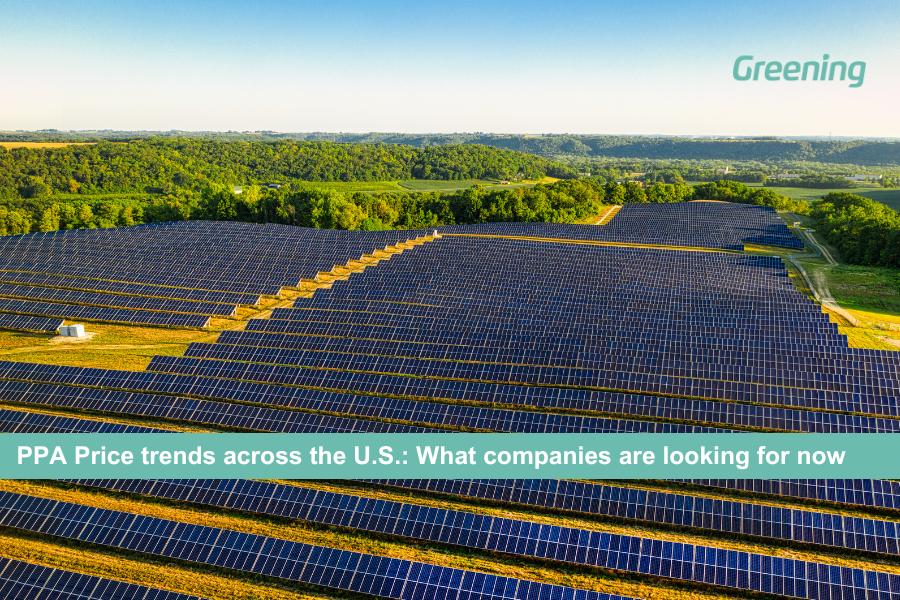
Over the past few years, corporate renewable energy procurement in the U.S. has entered a new phase of maturity. Power Purchase Agreements (PPAs), once considered innovative tools for sustainability leaders, are now mainstream instruments for managing energy costs, mitigating carbon exposure, and supporting long-term resilience.
But as the market evolves, so does the pricing landscape. In 2025, corporate buyers are navigating a more complex environment shaped by regional dynamics, financing conditions, grid congestion, and changing buyer expectations.
This article takes a closer look at how PPA prices have shifted across key U.S. markets, what’s driving those changes, and how companies are redefining value in their energy procurement strategies.

From Volatility to Stabilization
After sharp increases in 2022 and 2023, when solar PPA prices rose more than 35% year-over-year due to inflation, supply chain bottlenecks, and interest rate hikes, 2024 marked the beginning of a new phase: stabilization.
According to Level Ten Energy’s Q3 2024 Index, average PPA offers for solar projects in the U.S. have remained largely steady, with a national average around $52–$58/MWh for utility-scale solar, depending on region and contract structure.
This stabilization has been supported by:
- Falling equipment costs, particularly for PV modules as global oversupply from Asia increased.
- Easing interest rates, improving the cost of project financing.
- Stronger interconnection forecasting, allowing developers to plan more efficiently.
However, stability doesn’t mean uniformity, and regional differences remain significant.
Regional price dynamics: A fragmented landscape
The U.S. market is best understood as a mosaic of regional realities:
- ERCOT (Texas): Still the most competitive region for solar PPAs, with average prices ranging from $35–$45/MWh. Ample land, streamlined permitting, and a strong developer presence keep costs low. However, grid congestion and curtailment risks remain key concerns.
- MISO South (Arkansas, Louisiana, Mississippi): Prices hover in the $45–$55/MWh range. Attractive solar resources and growing industrial demand (especially from data centers) are driving new offtake activity, but interconnection timelines can stretch beyond three years.
- PJM (Mid-Atlantic): Among the most expensive markets, typically $65–$75/MWh, due to transmission constraints, limited project availability, and intense corporate demand.
- CAISO (California): PPA pricing remains high ($70–$85/MWh) but increasingly includes solar-plus-storage configurations, reflecting California’s focus on grid reliability and peak-hour energy delivery.
What Corporate Offtakers value most
As the market matures, corporate buyers have become far more strategic.
Today’s PPA negotiations center on three main pillars:
a) Financial hedging and long-term cost control
A well-structured PPA locks in a predictable cost of energy for 10–20 years, acting as a hedge against electricity market volatility. For many industrial buyers, the appeal lies in budget certainty and protection from wholesale price spikes, a growing concern as grid capacity tightens in several regions.
b) Decarbonization credibility
Scope 2 emission reductions are no longer symbolic; they must be traceable, auditable, and aligned with Science-Based Targets. Companies increasingly seek granular energy certificates (hourly RECs) and transparent impact reporting from their renewable providers.
c) Operational flexibility
Hybrid PPAs, pairing solar with battery storage, are rapidly gaining traction. These agreements give buyers access to energy during peak hours, enhance grid reliability, and support more flexible load management strategies.
What’s next for the PPA market
Looking forward to 2026, several factors will influence PPA pricing and availability across the U.S.:
- Module oversupply will continue to push equipment prices down, keeping solar competitive even without major incentives.
- Transmission upgrades announced under DOE’s “Grid Deployment Office” are expected to relieve congestion in parts of MISO and SPP by 2027, expanding PPA opportunities.
- Corporate demand will remain strong, particularly from data centers and heavy industry, both seeking long-term clean energy supply and cost stability.
- Interest rate trends will play a decisive role in financing economics for developers and offtakers alike.
In short: expect prices to remain steady or slightly decline in the next 12–18 months, but with persistent regional disparities and heightened competition for high-quality projects.

Key Takeaways for energy decision-makers
The corporate PPA market is no longer just about finding cheap renewable energy, it’s about building long-term energy resilience.
Companies entering this space should:
- Adopt a portfolio mindset: combining onsite, offsite, and virtual PPAs to balance exposure and flexibility.
- Prioritize execution credibility: partner with developers and EPCs that can deliver projects on time and manage operational risk.
- Evaluate total value, not just price: incorporating ESG alignment, location benefits, and grid reliability into procurement decisions.
PPAs have evolved from a sustainability commitment into a strategic financial instrument. In 2025, their value lies in aligning economic performance with climate ambition, securing not only clean energy, but also long-term competitiveness.
Looking ahead
As the U.S. grid grows more complex and corporate demand intensifies, the companies that thrive will be those that understand the market forces shaping PPA pricing, and partner with experienced energy players who can turn volatility into opportunity.
The conversation around renewables is no longer about “if” or “when”, it’s about how intelligently you procure, structure, and execute.
At Greening, we believe storage is not just the next step, it’s the enabler of a fully renewable future.
Learn more about how we’re developing and integrating utility-scale storage solutions across the U.S.
Contact us!