
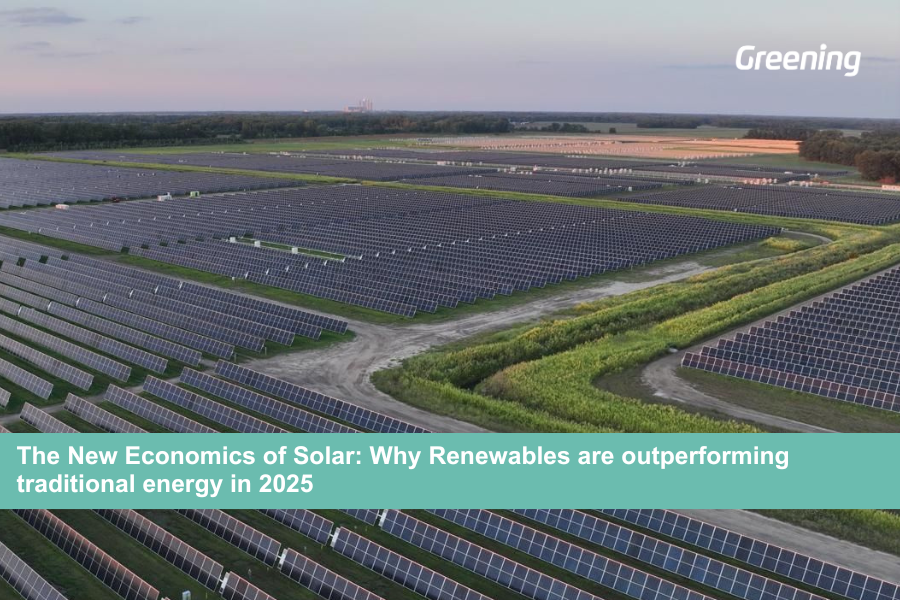
Over the past decade, the energy transition has moved from a long-term vision to a present-day economic reality. Solar power, once a niche segment supported largely by incentives, has become one of the most cost-competitive and scalable energy sources in the United States. In 2025, its value proposition is no longer driven only by sustainability goals, it’s driven by pure economics, operational resilience, and long-term cost control.
As the market evolves, a new question has emerged among corporate leaders and energy-intensive industries: Why is solar outperforming traditional energy now more than ever?
This article dives into the economic forces redefining the U.S. energy landscape, the drivers behind solar’s continued rise, and what this shift means for companies looking to secure reliable, affordable, low-carbon energy.

From Cost parity to Cost advantage
In the early 2020s, solar reached cost parity with fossil fuel electricity in many U.S. regions. But by 2025, that parity has turned into a clear cost advantage. The combination of lower equipment prices, improved financing conditions, and maturing supply chains has pushed the levelized cost of solar energy far below conventional generation in most markets.
According to new industry indices, utility-scale solar continues to hold one of the lowest generation costs in the country, even as federal incentives tighten. Average project costs have dropped steadily due to three main drivers:
- Lower PV module prices driven by global oversupply
• Stabilizing interest rates improving financing structures
• Smarter engineering and procurement strategies reducing construction timelines
In short, solar is no longer competitive because of policy, it is competitive because the economy stands on its own.
Why Solar is pulling ahead in today’s market
Behind solar’s rising advantage are market forces reshaping how companies think about energy. Three in particular are accelerating the shift.
- Electricity price volatility
As power demand increases, driven especially by data centers, manufacturing, and electrification, wholesale electricity prices in many regions have become more volatile. States like Texas, California, and parts of the Midwest are experiencing more frequent price spikes due to grid constraints and extreme weather.
Solar, on the other hand, offers a long-term cost hedge. Companies locking in fixed pricing through onsite generation or PPAs gain stability for 10–25 years, insulating themselves from market swings that fossil-based generation cannot avoid.
-
Grid Reliability challenges
Aging infrastructure, limited transmission capacity, and rising demand have created congestion across major markets. Regions like PJM and CAISO are experiencing growing reliability concerns, and costs are rising accordingly.
Solar paired with storage is emerging as a solution that not only reduces energy bills but also strengthens operational resilience. Hybrid renewable systems allow companies to shift load, support peak-hour demand, and avoid premium pricing windows.
-
Corporate energy strategy is changing
Energy is no longer just an operational cost. For many companies, it’s a strategic asset tied to competitiveness, ESG performance, and long-term risk management.
Today’s corporate buyers are prioritizing:
- Cost predictability
• High-quality renewable energy certificates (RECs)
• Hourly tracking and transparent emissions reporting
• Flexibility to support load growth from automation or AI expansion
That shift is accelerating demand for distributed solar, solar-plus-storage systems, and customized procurement structures.
The Big Turning Point: Solar as a Financial Tool
The economics of solar are now enabling companies to think beyond sustainability commitments. Solar is increasingly a financial instrument, a way to control long-term energy exposure, reduce operational uncertainty, and support multi-year capital planning.
Even companies with no public ESG targets are turning to solar for:
- Multi-decade visibility into energy costs
• Protection against rising grid fees
• Improved cash flow management
• Long-term competitiveness in manufacturing and industrial operations
In other words, solar is becoming a business strategy, not just an environmental one.

Renewables vs. Traditional energy: The 2025 Gap widens
While solar costs continue to decline, fossil-based energy faces upward pressure:
- Fuel price instability
• Higher insurance costs for thermal facilities
• Compliance and emissions reporting requirements
• Increasing grid congestion and network upgrade fees
Meanwhile, renewable developers are delivering projects faster thanks to standardized designs, global supply chain access, and optimized EPC models.
By 2025, the “new economics of solar” is clear: traditional energy sources can’t match solar’s combination of cost stability, resilience, and long-term certainty.
What this means for U.S. Companies
As the economics tilt further in favor of clean energy, organizations across all sectors, from logistics and cold storage to manufacturing and large commercial buildings, are reevaluating their strategies.
Companies leading the transition are:
- Combining onsite solar with offsite PPAs to balance cost and reliability
• Investing in battery storage to support peak load and operational continuity
• Working with experienced EPC partners to ensure project delivery and performance
• Integrating renewables into multi-year capital and energy planning
The companies that succeed in the next phase of the energy transition will be those that adopt a porfolio approach and view energy procurement as part of long-term financial strategy, not just an annual expense.
Final thought
The rise of solar in 2025 is not just a renewable energy story, it’s an economic transformation. The companies that thrive in the coming years will be those that understand these new market forces, take advantage of falling renewable costs, and partner with experienced players capable of delivering high-quality, reliable solar and storage solutions.
The question is no longer whether solar makes sense. It’s how quickly businesses can integrate it to secure a more predictable, resilient, and cost-efficient future.
Contact us for more info info.us@greening-group.com