
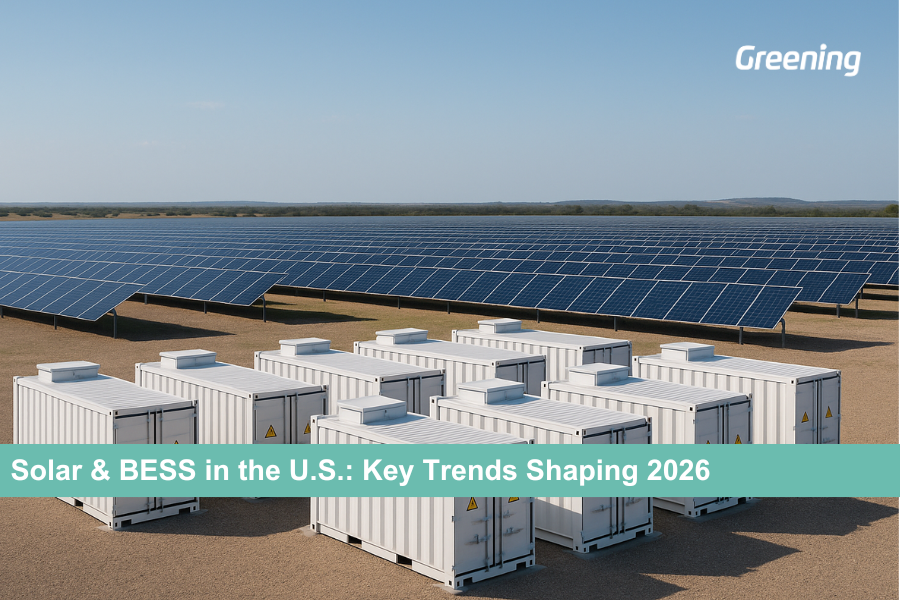
As 2026 gets underway, the U.S. solar and battery energy storage (BESS) market is entering a defining phase. After years of accelerated growth driven by policy incentives, corporate demand, and grid constraints, the industry is now shifting toward scale, optimization, and long-term resilience. For developers, energy buyers, and infrastructure investors, understanding what lies ahead is critical.
This outlook highlights the most relevant solar and BESS trends shaping the U.S. market in 2026, combining insights from leading industry reports, energy outlooks, and clean technology analyses, with a clear focus on what they mean for the American energy landscape.

Solar growth continues, but with a more disciplined pace
According to Deloitte’s U.S. Renewable Energy Industry Outlook, solar is expected to remain the largest source of new electricity generation capacity additions in the United States through 2026. After record installations in 2023 and 2024, annual solar capacity additions are projected to stabilize but still exceed 30–35 GW per year, keeping cumulative U.S. installed solar capacity on a strong upward trajectory (Deloitte, 2025).
Utility-scale and distributed solar remain central pillars of the U.S. energy transition. While the record-breaking installation volumes seen in the mid-2020s are expected to stabilize, total installed solar capacity continues to expand steadily. Industry projections indicate that solar will remain one of the largest sources of new generation capacity added in the United States through 2026, supported by declining technology costs and persistent demand for clean, domestic energy.
In the commercial and industrial (C&I) segment, companies are increasingly adopting solar not only to meet sustainability goals, but also as a financial hedge against long-term electricity price volatility. Rising grid congestion, regional capacity constraints, and exposure to wholesale market fluctuations are reinforcing the value of onsite and contracted solar solutions.
Rather than signaling a slowdown, this more measured growth reflects a maturing market, one that is prioritizing project quality, interconnection strategy, and long-term performance over rapid expansion alone.
Battery energy storage becomes essential, not optional
Battery energy storage is the fastest-growing segment of the U.S. power sector. S&P Global estimates that U.S. grid-scale battery capacity will grow at a compound annual growth rate (CAGR) of more than 20% through 2026, driven by renewable integration needs, capacity constraints, and market opportunities in ERCOT, CAISO, MISO, and the Southeast (S&P Global, 2025).
If solar defines the generation backbone of the U.S. clean energy system, battery storage defines its flexibility. By 2026, BESS is no longer viewed as an add-on, but as a core component of new solar developments and grid planning strategies.
Across key U.S. markets such as Texas, California, the Midwest, and the Southeast, battery installations are accelerating to address peak demand, manage intermittency, and improve grid reliability. By 2026, total installed U.S. battery storage capacity is expected to surpass 60–70 GW, compared to less than 20 GW at the start of the decade, underscoring how quickly storage has moved from niche to necessity (Energy Evolution Conference analysis, 2025). Storage duration is also evolving, with four-hour systems becoming standard and longer-duration solutions gaining attention for capacity and resilience needs.
For utilities, storage enables better integration of renewables while reducing reliance on peaker plants. For corporate energy buyers, BESS enhances the value of solar by enabling demand for charge management, backup power, and participation in emerging grid services markets.
Grid constraints and interconnection drive smarter project design
Interconnection remains one of the most significant bottlenecks for solar and storage deployment in the U.S. According to S&P Global, more than 2,000 GW of generation and storage projects were sitting in U.S. interconnection queues as of 2024, with solar and hybrid solar-plus-storage projects representing the majority (S&P Global, 2025).
One of the most influential trends shaping solar and storage deployment in 2026 is not technological, but structural: grid congestion. Interconnection queues across the U.S. remain lengthy, particularly in high-growth regions. As a result, developers are increasingly optimizing projects around grid realities rather than ideal site conditions alone.
Hybrid solar-plus-storage projects are becoming a strategic response to these challenges, allowing developers to better control export profiles and maximize interconnection capacity. At the same time, there is a growing emphasis on early-stage grid analysis, flexible system sizing, and creative offtake structures to improve project bankability.
In this environment, experience, engineering expertise, and a deep understanding of regional transmission dynamics are becoming decisive competitive advantages.
Corporate demand and long-term power strategies evolve
Corporate renewable energy procurement continues to be a key demand driver in the United States. Deloitte reports that large commercial and industrial buyers have contracted over 200 GW of renewable capacity globally, with the U.S. accounting for the largest share. In 2026, corporate buyers are increasingly prioritizing projects that provide firm, dispatchable clean energy rather than energy-only profiles (Deloitte, 2025).
U.S. corporations remain a major driver of renewable energy demand, but their approach is evolving. In 2026, many large energy buyers are shifting from purely volume-based procurement to more sophisticated strategies that balance cost, risk, and reliability.
This includes increased interest in:
- Solar and storage solutions that provide both energy and capacity value
- Hybrid PPAs that combine renewable generation with storage-backed delivery profiles
- Regional sourcing strategies aligned with load centers and grid constraints
As ESG commitments mature, companies are also placing greater emphasis on additionality, project transparency, and measurable emissions reductions within the U.S. market.

Technology innovation focuses on efficiency and integration
Technology innovation in 2026 is centered on efficiency, integration, and reliability. According to industry analyses highlighted by S&P Global, average utility-scale solar module efficiencies deployed in the U.S. are now exceeding 22%, while advances in power electronics and digital asset management are improving plant-level performance and reducing curtailment risk.
While dramatic cost declines have characterized the past decade, innovation in 2026 is centered on performance optimization rather than disruption alone. Advances in module efficiency, inverter technology, and digital monitoring are improving output and reducing operational risk across solar assets.
In parallel, BESS technology is benefiting from improved energy density, safer chemistries, and more sophisticated control software. These improvements are enabling better integration with solar plants, grid systems, and customer load profiles, reinforcing the role of storage as a multi-use asset rather than a single-function solution.
Policy stability matters more than expansion
The policy environment in the U.S. remains supportive but increasingly execution focused. Deloitte notes that while federal incentives continue to underpin project economics, long-term growth through 2026 will depend more heavily on permitting reform, transmission expansion, and grid modernization than on new subsidy mechanisms (Deloitte, 2025).
In the U.S., the policy environment in 2026 is defined less by new incentives and more by the effective execution of existing frameworks. Market participants are focused on regulatory clarity, permitting efficiency, and transmission of investment as the next enablers of growth.
Rather than relying solely on policy-driven economics, solar and storage projects are increasingly expected to stand on their own financial and operational merits. This shift further underscores the importance of disciplined development, reliable EPC execution, and long-term asset performance.
Looking ahead: a resilient and strategic market
The U.S. solar and BESS market in 2026 is not slowing down, it is leveling up. Growth continues, but with greater emphasis on resilience, integration, and strategic value. Solar remains a cornerstone of new power generation, while battery storage has become indispensable to grid stability and energy management.
For stakeholders across the energy ecosystem, success in 2026 will depend on the ability to navigate grid complexity, align projects with real-world demand, and deliver solutions that combine clean energy with reliability and cost certainty.
At Greening US, we see this moment as an opportunity to build smarter, more resilient renewable energy solutions, designed not just for today’s market, but for the energy system the U.S. will rely on in the decades ahead.
Ready to plan your 2026 energy strategy?
Whether you are evaluating solar, battery storage, or hybrid solutions, having the right partner makes all the difference. From early-stage project development to fully integrated solar and BESS solutions, we work with corporate energy buyers, developers, and utilities to deliver reliable, cost-effective clean energy projects across the United States.
If you are planning your renewable energy strategy for 2026 and beyond, now is the time to start the conversation.
Contact us: info.us@greening-group.com